
Bug bounty programs have a math problem, and it's getting worse.
AI models can find vulnerabilities now. Automated agents probe APIs and scan code at a speed no human research team could match, and they're filing reports right alongside human researchers. The volume hitting bug bounty programs is climbing, and it isn't going to slow down.
That should be good news. More eyes on your code means more bugs caught before an attacker finds them. But it only helps if someone can tell the real findings from the noise, work out where each one actually lives in your code, and get it fixed. Most teams can't keep up. Reports pile up. Developers ignore tickets they can't reproduce. And the same kinds of bugs come back every quarter, because nobody had time to fix the actual cause.
Today we're announcing our partnership with Bugcrowd, built to close that gap. Every report from your Bugcrowd program now flows straight into Pi, which takes it from raw text to a fix your developers will actually merge, usually in under 30 minutes.
What happens in those 30 minutes
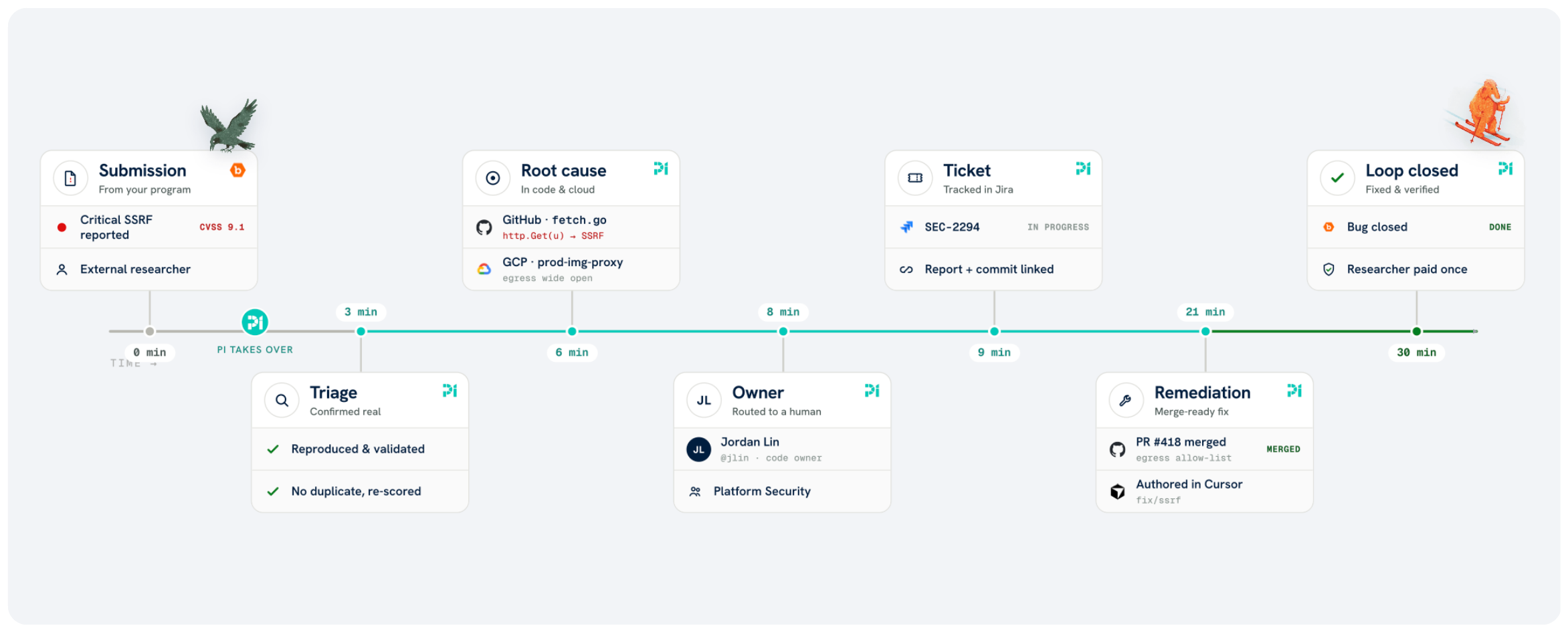
Walk through a single report.
At minute zero, a researcher submits a finding to your Bugcrowd program. It's unstructured text: a user can open another customer's invoices by changing an ID in the URL. That's all you get. An outsider's description of something that might be wrong.
Pi takes it from there.
First it confirms the bug is real. Not by reasoning about the description, but by reproducing it. Pi spins up the attack path inside a sandbox, runs it dynamically, and watches what happens. If the data comes back, the finding is confirmed. If it doesn't, or if the behavior turns out to be handled by a control the researcher couldn't see, Pi clears it before anyone on your team spends a minute on it. At the same time, it checks the report against everything already in your system, so a duplicate or a months-old resubmission gets flagged instead of paid out twice.
Then it scores the real severity. Pi already knows this service faces the internet and handles billing data, so it weighs the finding against that reality, not the number the researcher guessed.
Now the part that makes the difference. Pi traces the bug to its source in your code. The researcher found it on one endpoint, so the obvious move is to patch that endpoint. Pi doesn't make the obvious move. It understands how your applications fit together: which service calls which, where requests flow, where the authorization checks actually live. And it can see that the missing check doesn't belong on that one handler. It belongs in the shared middleware sitting in front of dozens of endpoints. Patch the single endpoint and you've fixed one bug. Fix the middleware and you've closed the same hole on every endpoint behind it, including the ones nobody had reported yet.
Knowing where a fix truly belongs is the hard part of security, and it's the part other tools can't do, because they read code in isolation. They see the syntax. They don't see the system.
From there it's quick. Pi routes the finding to the team that owns that middleware. It writes the fix as a pull request in your codebase's own style and conventions, tuned to how your code is written and how it's deployed, so it reads like something your team wrote rather than a generic snippet pasted in. Across our customers, about 60% of these pull requests merge with no edits at all. The developer reviews it, merges it, and Pi catches the merge, closes the finding, and syncs the status across Bugcrowd, Jira, and your repo. The researcher gets paid once, for the real bug.
Thirty minutes. One report in, one fix out, and a row of endpoints quietly secured along the way.
Why the same bugs stop coming back
Most security work is symptom management. A bug is found, a patch goes in, the team moves on, and the same class of bug shows up somewhere else next quarter. The cause was never addressed, so the work repeats forever.
Pi is built to end that loop, and it does it in two ways.
The first you just saw: fix the cause, not the instance. By finding the right layer to fix, Pi closes every vulnerability that shares the same root, not just the one in the report. And it doesn't stop inside one application. Once a bug is confirmed, Pi looks for every other place the same pattern exists across all your repositories, searching by what the code actually does rather than by matching text, so it catches the same flaw even when it looks different on the surface. You paid one bounty. You got your whole codebase checked.
The second is what keeps the bug gone. Every fix teaches Pi something, and it keeps what it learns. When a vulnerability is resolved, the pattern behind it becomes a guardrail that Pi applies to every future pull request automatically. The next time someone writes the same mistake, whether it's a new hire who didn't know the convention or a developer who pasted in old code, Pi catches it at review, before it ever merges. These guardrails aren't a static rule set somebody has to write and maintain. They build themselves from your own findings, and they get more complete every time Pi closes something.
This is also why the knowledge survives people leaving. At one customer, a bug that was fixed in October reappeared months later, because a developer accidentally overwrote the fix in the main branch. Pi recognized the pattern coming back and flagged it on the spot. Nobody had to rediscover the fix. Pi already remembered it.
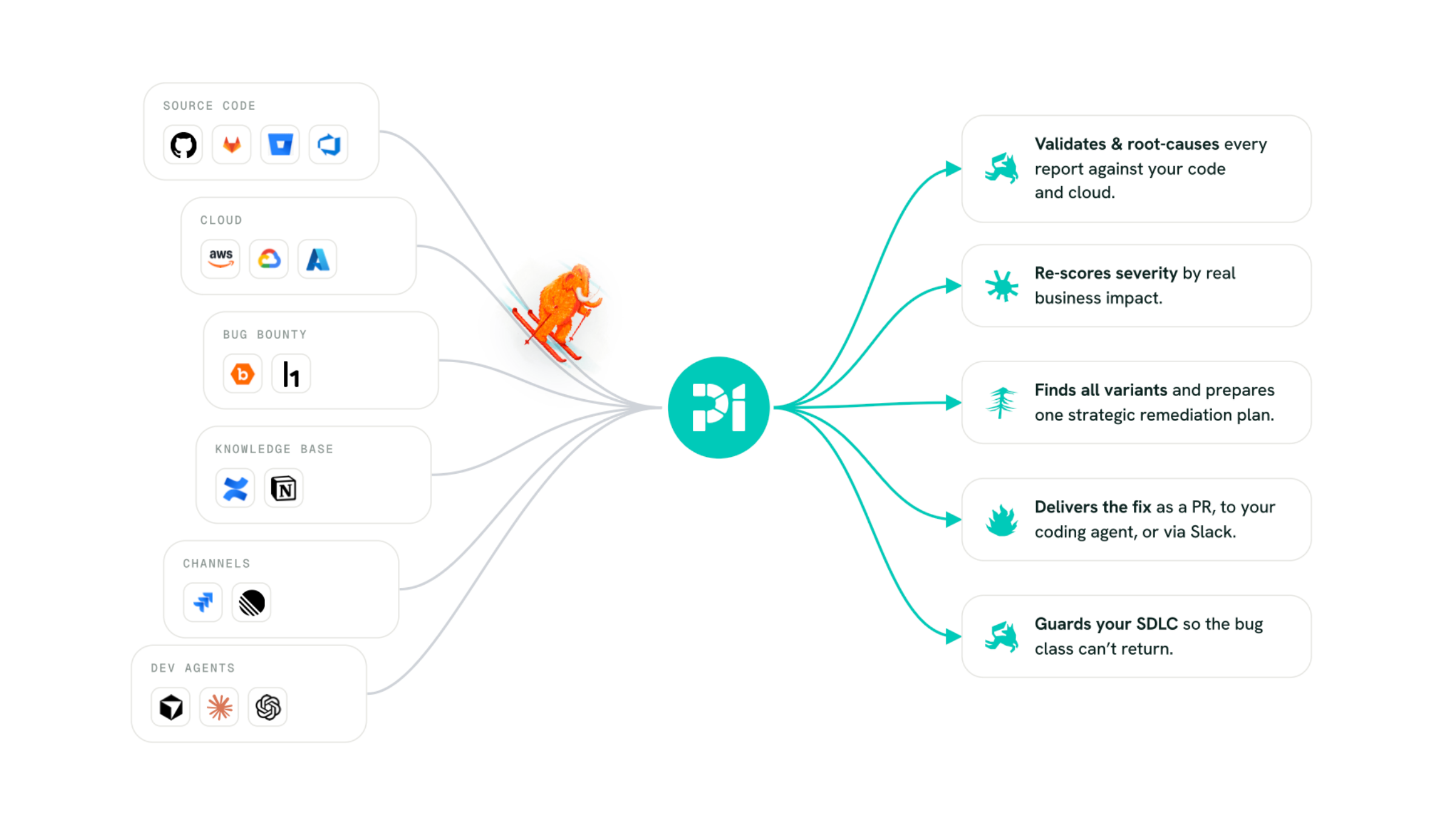
What you connect, and what Pi does.
What the partnership means for your program
Bugcrowd brings the researchers, the submissions, and the program. Pi takes every report that lands and does the work that used to eat your team's week: confirming what's real, scoring it honestly, finding where it actually lives, writing the fix, hunting the variants, and making sure the class can't return.
The result is a bug bounty program that compounds. Every report makes your codebase more secure, one root cause at a time instead of one endpoint at a time. Your researchers get faster responses. Your developers get fixes they'll merge. Your security team spends its time on the work that moves the needle, not on reading and routing reports.
Pi onboards in under 25 minutes. If you're running a Bugcrowd program, the reports already in your queue can start paying back their full value today.
contact@pi.security | See it in action